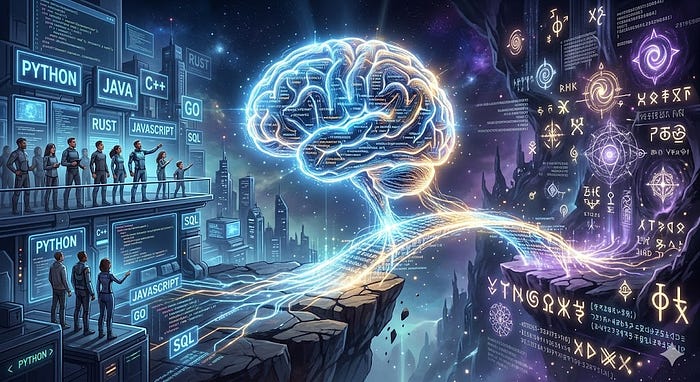

We have always assumed that code belonged to us. We used it as a bridge, creating a proprietary language for our brains to communicate with mindless silicon. C++, Rust, Python, and Java. They use human-like syntax, including if, else, return, and while. They mirror how we think, categorize, and reason.
However, that bridge was designed for a time when computers were merely executors of human will. The landscape is currently evolving. Artificial intelligence is increasingly bypassing human language, rather than just writing code. It’s starting to design its own.
This is no longer considered a classic science fiction trope. Advanced researchers are currently studying neural code creation, token hyper-compression, and automated compiler optimizations. The initial signs are subtle but clear. Deep neural networks prioritize minimizing latency over human legibility when optimizing workflows. AIs develop unique internal structures, proprietary representations, and machine-readable protocols tailored to other AIs.
The system is removing the human overhead. This presents an unnerving question: if AI develops programming languages that humanity cannot understand, will we gain complete computational power or lose visibility?
| The Birth of the Non-Human Dialect
Take a look at how we create code to see why this is happening. Human code is purposely inefficient. Whitespace, descriptive variable names, specific indentation, and structured logic trees are necessary for developers to debug code even at 3:00 AM. It addresses the severe cognitive limits of human working memory.
An AI model has no such constraints.
When an LLM or autonomous agent interacts with another system, they communicate using Python or JSON, similar to two supercomputers using Morse code. It is extremely slow, bloated, and computationally expensive. Models are learning to condense difficult multi-step logical operations into dense, multi-dimensional token arrays.
“We are no longer just instructing machines; we are constructing minds that find our language too primitive to use.”
Consider how modern compilers automatically optimise code. They convert our well-written logic into machine code that differs significantly from the original. Now, eliminate the middleman. AI systems can train, reason, and self-correct without relying on human grammar. It creates a private taxonomy with optimized syntax for low latency, mathematical efficiency, and fast cross-model communication.
| Power vs. Visibility: The Great Trade-Off
This evolution brings us to a critical juncture. On the one hand, unprecedented operational power is promised by allowing AI to create its own programming languages. Programs that reduce their footprint to a fraction of a kilobyte, software that optimizes its execution patterns in real time, and automated systems that can solve extremely difficult reasoning loops without human lag are all possible.
However, the cost is quick and significant: we lose visibility.
When software is rewritten in a language that differs from human syntax, standard debugging methods become obsolete. The “Black Box” problem is now the core of our digital infrastructure, rather than just a theoretical obstacle related to brain weights. We won’t be able to access the source code as there will be no human-written code remaining.
| The Future is a Negotiation, Not a Command
For decades, programming was a form of total sovereignty. A line of code you typed was precisely executed by the machine. It was a human error if something went wrong.
Programming will change from being an act of direct command to a sophisticated negotiating process in this impending future. We shall find ourselves standing on the edge of our own systems, establishing high-level limits, specifying ethical limitations, and requesting particular results — all the while leaving the internal logic, language, and execution to a system whose precise thought process we are unable to track.
We are not only looking at a new generation of software tools. Technology is becoming less understandable to humans. As machines develop their own ways of thinking, the ultimate test will be our ability to negotiate with a silent syntax that we were not designed to read.