

Key takeaways for a roadmap leaders will use
- Start with business outcomes. If the roadmap does not connect to growth, control, customer experience, or risk, it will sit on the shelf.
- Write in plain language. Executives should be able to scan it fast and know what changes, who owns it, and what it costs.
- Make tradeoffs visible. Every yes should show what gets delayed, what gets harder, and what risk you’re accepting.
- Keep it alive. A roadmap only works if you review it on a real cadence and update it when the business changes.
Start with the business problem, not the tech list
Your roadmap should not begin with systems. It should begin with the pressure your business is under.
If you start with tools, you get a wish list. If you start with the business problem, you get direction. That direction might come from growth strain, weak reporting, vendor drift, cyber risk, or a leadership gap. The roadmap has to answer a simple question, what is technology supposed to help the business do next?
That is why business-aligned technology strategy matters. It keeps the conversation on outcomes, not noise. A leadership team can work with a roadmap only if it speaks the same language they already use in meetings, board updates, and budget reviews.
Identify the outcomes your leadership team actually wants
Vague goals sound nice and do almost nothing.
“Modernize systems” is vague. “Cut manual handoffs by 40 percent” is useful. “Improve efficiency” is vague. “Reduce release delays and get new products out faster” gives you something to plan around.
You want a small set of outcomes that leadership already cares about. Think in terms of faster launches, fewer outages, cleaner board reporting, less manual work, better customer handoffs, or lower vendor dependence. Each roadmap item should connect to one of those outcomes. If it does not, it belongs in the parking lot until it earns its place.
Separate symptoms from the real problem
Slow projects are usually not the problem. They are a symptom.
Tool sprawl, weak reporting, and vendor drift often point to something deeper. You may have an ownership problem. You may have an unclear priority stack. You may have no one holding the line on risk. Or you may have a leadership gap where technology decisions are getting made, but not really owned.
That distinction matters. If you treat symptoms as the whole story, you end up buying more tools, adding more meetings, and creating more noise. If you name the real issue, you can build a roadmap that fixes the source.
When the problem is unclear ownership, you may need more than a plan. You may need help to Talk Through Your Technology Leadership Gap.
A roadmap is only useful if it helps people make choices.
Turn the roadmap into a decision tool leaders can use
Your executives do not need a document that proves work is happening. They need something that makes priority, timing, ownership, cost, and risk easy to see. Think of it as a decision map, not a project dump. That shift changes everything.
A useful roadmap helps you answer, “What are we doing now, why now, and what are we not doing because of it?” That is the kind of clarity that holds up in a budget meeting.
Use plain language that matches how executives think
Write the roadmap in business terms, not technical jargon.
Do not lead with system names unless they matter to the decision. Lead with customer impact, revenue risk, reporting gaps, operational drag, or compliance exposure. If a line item says “reduce failed handoffs in intake,” most leaders understand it. If it says “re-architect service orchestration layer,” you’ve already lost the room.
This is where a lot of roadmaps break. The team knows the work. Leadership does not know what it means. When the language is clear, the roadmap becomes easier to trust. And when leaders trust it, they can actually use it.
Make ownership, timing, and tradeoffs obvious
Every roadmap item should answer four questions.
Who owns it?
When does it happen?
What does it depend on?
What gets delayed if you move it?
That is where the real value sits. A roadmap without ownership is a wish. A roadmap without timing is a theory. A roadmap without tradeoffs hides the true cost of saying yes.
If ownership is fuzzy, decisions stay fuzzy. If your teams are still arguing over who owns what, the roadmap will not fix that on its own. It may be time for stronger structure, clearer decisions, and a more honest conversation about tech leadership services tied to priorities.
Keep the format simple enough to review in a meeting
If leadership cannot review the roadmap in one meeting, it is too heavy.
You do not need a 40-page deck. You need something that fits on a page or a small set of slides. It should include a short summary, a few priorities, what is in motion, what is next, and what decision you need from leadership. That keeps the conversation tight and practical.
The point is not to impress people with detail. The point is to make approval, redirection, or pause decisions easier. Good roadmaps reduce friction before the work starts.
Build the roadmap around clear phases and real constraints
Your roadmap should feel realistic. If it reads like a fantasy, nobody will trust it.
That means you need to show what happens now, what happens next, and what gets pushed out. Leaders can live with hard choices. They cannot work with vague ambition. A roadmap that respects budget, capacity, and timing gives them something they can defend.
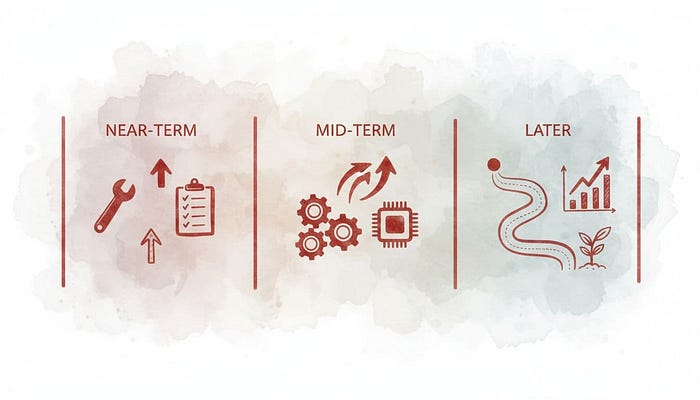
Group work into near-term, mid-term, and later priorities
Do not flatten everything into one long list.
Split the work into three buckets. Near-term items are the fixes you can make now. Mid-term items are the improvements that need a little more setup. Later items are the bigger moves that should wait until the foundation is stronger.
That structure keeps you honest. It also gives leadership a clearer view of what can happen without overpromising. A good roadmap does not pretend every idea deserves the same urgency.
Account for team capacity, vendor limits, and budget reality
A roadmap only works if people can do the work.
If your plan depends on heroic effort, late nights, and vendors who always say yes, it is not a roadmap. It is a bet. You need to look at internal bandwidth, outside support, and how much budget is actually available. Then you need to be honest about what those limits mean.
This is where too many plans drift off course. They assume more capacity than exists. They assume vendors will move faster than they do. They assume the business can absorb the work without disruption. It usually cannot.
Show the risks of waiting, not just the cost of doing the work
Delay has a price.
Waiting too long can increase spend, deepen tool sprawl, slow growth, and leave risk sitting in the blind spot. It can also make later change more expensive than it needed to be. That is why the roadmap should show the cost of inaction, not just the cost of execution.
If you need help spotting where technology is draining value instead of creating it, you may want to Find What Technology Is Costing Your Growth. The answer is often already sitting inside the roadmap, if you’re willing to look at it honestly.
Keep the roadmap alive after it is approved
Approval is not the finish line. It is the start of the work.
If the roadmap goes quiet after the meeting, it becomes decoration. You want it in the rhythm of leadership conversations, budget reviews, and risk discussions. That is how it stays useful when the business changes.
Use a simple review cadence that leadership will follow
Monthly or quarterly reviews work better than crisis-driven check-ins.
Keep the cadence simple. Review what moved, what slipped, what risk changed, and what decision needs attention next. You do not need a long ceremony. You need a steady habit that keeps the roadmap connected to reality.
That kind of rhythm also helps leaders stop guessing. They can see progress, ask sharper questions, and reset priorities before the gap gets expensive.
Track a few metrics that prove progress matters
Keep the scorecard small.
Track project delivery, system reliability, ownership clarity, vendor performance, or reduced manual work. That is enough to tell you whether the roadmap is doing its job. More reporting is not the goal. Better reporting is.
If the board or executive team needs a cleaner view of risk and execution, that may be the moment to Build a Board-Ready Technology Risk View. Leaders do not need more data. They need signals they can act on.
Refresh the roadmap when the business changes
A roadmap should change when the business changes.
Growth, acquisition prep, leadership turnover, cyber pressure, or a major vendor issue should trigger a review. If the roadmap still reflects last quarter’s assumptions, it’s already behind. You do not need to rebuild it every time something shifts. You do need to keep it current enough to guide real decisions.
For companies in transition, it can also help to Prepare Technology for Diligence or Transition. Change exposes weak ownership fast, and the roadmap should show that you saw it coming.
Conclusion
A technology roadmap only matters if leadership can use it. That means it has to start with business problems, not a pile of technical tasks. It has to show ownership, timing, tradeoffs, and risk in plain language.
When the roadmap is easy to explain, easy to review, and easy to act on, it is doing its job. It gives you clearer visibility, better decisions, and a calmer way to handle technology under pressure.