
People keep bragging to me about their AI slop and expect me to be impressed
A colleague texted me the other day. “Hey, I was thinking about the intersection of X and Y, and I wrote an article about it. Here it is,” he said.
The first red flag was that I know this guy isn’t a writer, not even close. I also know that he’s a hard believer in all things AI.
Still, I clicked the link, and I couldn’t even finish the first sentence of the article: “In the ever-evolving landscape of…” it began, the quintessential AI-writing tell.
I wanted to throw the phone at the wall. I wanted to call him and scream, “Just admit you wrote the whole thing with AI. Why lie about it?”
AI writing is so awful, and professional writers are especially attuned to the tells. Those of us who write (or wrote — past tense) for a living can sense AI slop a mile away.
So when someone comes and says to a pro, “Oh, look what I wrote. It’s so good!” and then we see that it isn’t very good at all, but rather crappy, and perhaps even embarrassingly bad, then we, as pros, curl our lips and say, “But that sucks. It really, really sucks.”
That’s when the person who “created” the work usually starts throwing their toys out of the cot.
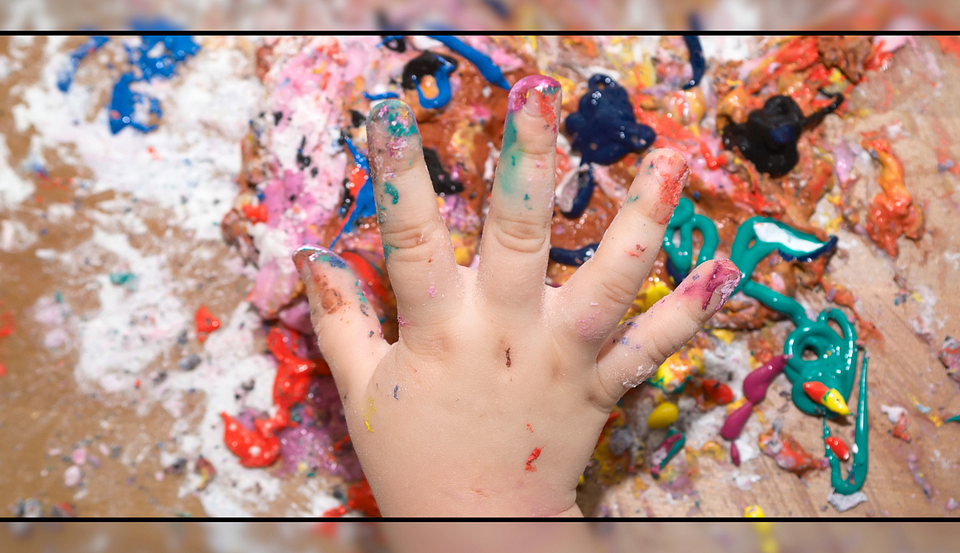
Keep this image in mind as we move on, because there’s an important point to all this that might even give you some hope in this world drowning in AI slop.
A little exercise
Now, I apologize in advance for the next exercise because I know many of you have exited LinkedIn because of its AI problem and never want to look back. But the exercise is necessary:
Think back to the last time you scrolled LinkedIn (sorry!) and all the cringeworthy AI slop you found on there. The creators of that slop typically pass it off as “This is a highly intelligent post that I wrote because I’m such an insightful executive.”
Meanwhile, everyone’s looking at the post, then looking at each other, saying, “We totally know that AI did that for you. Do you even know what it says?”
These posts make me think of one thing: Little children with crayon-lines scribbled all over the page, saying, “Look! Look! I made this! I made it!” and the adults crowding around them, patting them on the heads, saying, “So good, little Johnny. Absolutely wonderful, baby Jenny,” and the kids run off to create yet another crayon-drawing, bring it back, and the adults say, “So Amazing. Go do another one!”
And they do.
Again, and again, and again, totally oblivious to the fact that their work is worthless in the world that exists beyond their parents.
Spotify’s AI Slop
The very next day, someone sent me a text on WhatsApp: “Hey, check out this amazing song created by [a person I know who most certainly is not a musician].”
The song had these “beautiful,” deep African voices. I write “beautiful” in quotation marks because those deep African voices really are beautiful — the real ones, the human ones. They’re exquisite. They produce that resonant, soulful music of Southern Africa. I grew up adoring that music, mostly because I was amazed that humans could make that sound. I also knew that the human singing that song had an emotion behind it.
Art appreciation is more than the final product. It isn’t only a matter of the voices themselves. It’s how the voices of multiple singers are perfectly coordinated, how they maintain that timbre throughout an entire song, and how they prevent their voices from breaking.
A few things struck me about the Spotify “song” sent to me: I doubted this person had access to such professional singers. Second, the album art was clearly AI-generated. Third, the person had made another song, this time with the “beautiful” voice of a female singer.
That’s when I realized this was AI. I clicked off. When I listen to music and appreciate voices, instruments, arrangements, and all the things that make music beautiful, I am appreciating the human mastery that created that music.
This isn’t a moralistic stance. It’s why people love art.
It’s not only the sound itself, it’s also about how that sound is made.
Art enthralls me because I am constantly astounded by the dedication it takes for someone to train their voice for years, or to learn to play the piano, or to wield a paintbrush, or to tell a story. It’s not only “the final product” that makes people appreciate art. It’s knowing that a human did it.
There’s another thing about AI-generated “music”: It’s constant. Every word is precisely pronounced. It’s statistically perfect.
It’s fucking boring.
When I discover a song I love, I typically listen to it hundreds of times over the course of a few days. It grows on me. I love it more and more.
After becoming aware that Spotify has a massive AI problem, I looked over my playlist. I had a suspicion about one particular song because, after listening to it twenty or thirty times, it started grating on me. Something wasn’t quite right about it, and I couldn’t put my finger on it.
Now I could: It had a “perfect” rhythm, the words “sung” with perfect eloquence.
Except for one thing: It hadn’t been “sung” at all. I googled the artist. I searched everywhere. But he was nowhere to be found.
The song had been AI-generated.
I felt tricked, not because I didn’t like the rhythm. I did. But what I’d really loved was how someone could control a voice that’s so deep. I thought, “Man, for a dude to have such a deep voice and then train it to maintain such an excellent pitch is incredible.”
No one had trained that voice, and I didn’t give a damn about an electronic voice like that, whether it was AI-generated or not.
We love art because it shows us what other people can do that we can’t.
The snide, condescending arguments made by AI zealots that “Oh, you can’t even tell the difference, so why is one better than the other?” disappear on the basis that the artwork made by the human can only be made by that human. And the artwork made by the digital machine can be made by anyone.
Why would I appreciate anything I could easily create myself?
Note that word: Easily.
The ridiculous “Monet Thought Experiment”
Some know-it-all on LinkedIn recently decided to share the dumbest, nonsensical AI-defending post that went something like this: “Someone posted a picture of a Monet and told everyone it’s an AI-generated image, then asked why a Monet is better than the AI-generated image.” Apparently, people streamed in with comments about how the AI image was dull, was this, was that, etc.
“Tada! All you commenters are idiots because — tralalalala — this is actually a real Monet!”
Okay? Was I reading this right?
A Monet, which is a physical object made of paint on a canvas in a time period when artists were rebelling against realism and bucking the trend to display their art is being compared… to a digital photo?
Get that: A digital photo of a Monet is not a real freaking Monet!
This is the argument being fed to us as “scientific”?
You have got to be kidding me.
Folks, we have officially entered the Idiocracy.
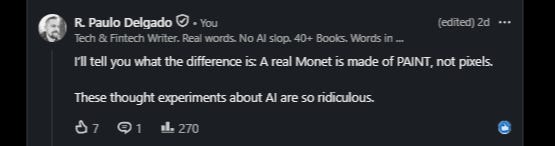
LinkedIn AI zealots like to condescend to the rest of us, all while limbering up their fingers, and typing away a prompt like, “Write me a post that posits why an AI-generated image is better than a Monet.”
These are five-year-olds throwing their crayon drawings at us.
To these geniuses: Your crayon drawings are awful.
To the artists being hit by this crap: Stop paying attention to it.
If you don’t understand that, then you’ve never argued with a five-year-old. The only thing to do with a five-year-old who insists they’re right is to ignore them and do your own thing. They’ll eventually learn. Life eventually teaches them.
No matter how many times those of us in a professional field point out to the AI-lovers how mediocre their “work” is in our field, they come back at us again with yet another “example” of what they just created in thirty seconds, and how we artists are so stupid.